Extension profile
.eu Domain: European Union ccTLD Guide
.eu is the regional top-level domain for the European Union.
Overview
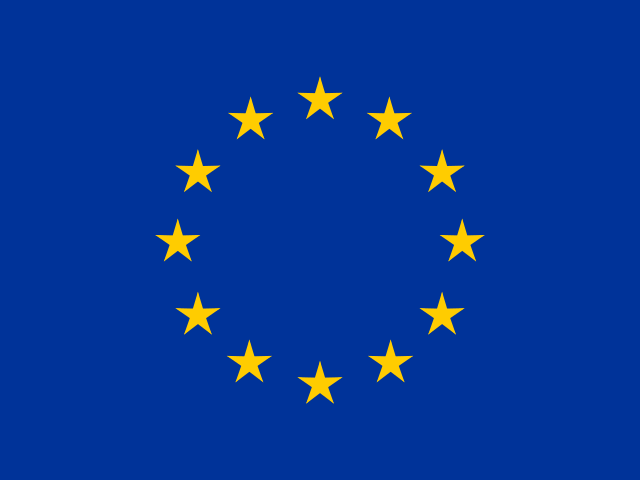 European Union
Used by organisations and individuals who want a pan-European identity.
.eu is not a country code: "EU" is an exceptionally reserved code in ISO 3166, and .eu is run by EURid.
After Brexit, many UK-based holders without another EU connection lost eligibility, a good reminder that ccTLD rules can change underneath existing owners.
Who can register
Open to citizens of EU/EEA countries wherever they live, to residents of those countries, and to organisations established there.
Rules and prices change. This summary is general information, not legal advice: confirm the current policy with the registry before you buy. The registry's website is eurid.eu. The official record for .eu is in the IANA root zone database.
Before you buy a .eu name
- Check the renewal price as well as the first-year price. Our cost calculator shows what a name really costs over time.
- Make sure you meet the eligibility rules yourself, without relying on a trustee if you can avoid it.
- Search for trademarks and for the same name in .com.
- Say the name out loud: will people type it correctly?
Weighing up a specific .eu name? TLD.is gives an AI appraisal that explains a name's strengths and weaknesses.
Frequently asked questions
What country is .eu?
.eu is the regional top-level domain for the European Union.
Who runs the .eu domain?
The .eu registry is managed by EURid vzw.
Can I register a .eu domain from another country?
Open to citizens of EU/EEA countries wherever they live, to residents of those countries, and to organisations established there.
Does Google treat .eu as a country domain?
Google treats .eu as a regional ending rather than a single-country signal.
Compare and explore
Compare .eu side by side with other extensions, or browse more in Europe:
 .at
.at .be
.be .ch
.ch .cz
.cz .de
.de .dk
.dk .es
.es .fi
.fiSources checked: eurid.eu. Last reviewed October 2026.
Keep reading
What Is a ccTLD?
The complete guide to country-code top-level domains.
ccTLD vs gTLD
How country-code and generic extensions differ, and when each fits.
Domain Hacks
How .io, .ai, .tv and friends became words, and a tool to find your own.
Choosing an Extension
A step-by-step method for picking the right ending.